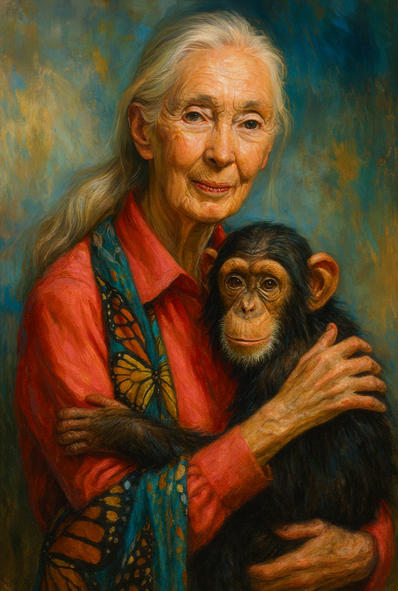
In a world increasingly obsessed with curated appearances, Jane Goodall stood as a quiet counterpoint—a woman whose presence radiated a kind of beauty that could not be bought, bottled, or broadcast. She was not in the business of beauty, and yet she embodied it. Not the kind that flickers across screens or sells in seasonal campaigns, but the kind that endures: clean, natural, and rooted in purpose.
Goodall, who passed away at 91, leaves behind a legacy that reshaped science, conservation, and the way we understand ourselves in relation to the natural world. But beyond her groundbreaking work with chimpanzees and her tireless advocacy for environmental justice, she offered something subtler and perhaps more radical: a model of how to live beautifully without ever chasing beauty.
The Unstyled Icon
Jane Goodall never needed styling. Her look—long silver hair pulled back into a simple ponytail, a high-collared shirt, a shawl patterned with butterflies or leaves—was as consistent as it was uncontrived. It was not a brand, not a statement, not a strategy. It was simply her. And in that simplicity, she became iconic.
There was a type of clarity to her appearance. She understood the power of natural, the elegance of restraint. Her wardrobe was functional, earthy, and quietly expressive. It spoke of forests and fieldwork, of long days spent observing rather than performing. And yet, when she stepped onto a stage or into a photograph, she carried the kind of presence that fashion editors dream of: composed, luminous, unforgettable.
Her face, lined with time and thought, was never hidden behind makeup. Her eyes, clear and observant, seemed always to be looking beyond the moment. She wore her age with grace, her convictions with pride, and her humanity with humility. In an era that often equates visibility with value, Goodall reminded us that true beauty is not in the spotlight—it’s in the substance.
Beauty as Integrity
What made Jane Goodall beautiful was not her cheekbones or her silhouette. It was her integrity. She lived in alignment—with her values, her work, and the creatures she devoted her life to understanding. That alignment gave her a kind of radiance that no product could replicate.
She did not chase trends. She did not reinvent herself with each season. She did not need to. Her life was her look, and her look was her life. The ponytail, the pressed shirt, the butterfly shawl—these were not affectations. They were expressions of a woman who had chosen clarity over clutter, purpose over polish.
In this way, Goodall offered a kind of fashion wisdom that transcends the industry. She showed that style is not about adornment—it’s about coherence. When your outer life reflects your inner life, you don’t need embellishment. You become, quite naturally, compelling.
The Editorial Eye
To observe Jane Goodall was to witness a masterclass in visual storytelling. Her photographs—whether taken in the forests of Gombe or on the stages of global summits—tell a story of presence. She never posed. She never performed. She simply was. And in that being, she became unforgettable.
Editors often speak of “the shot”—that moment when everything aligns: light, expression, composition. Goodall lived in that moment. Her posture, her gaze, her quiet confidence—all of it created images that linger. Not because they were styled, but because they were true.
There is a reason her portraits feel timeless. They are not anchored to fashion cycles or cultural trends. They are anchored to something deeper: a life of meaning. And in that meaning, we find a kind of aesthetic that transcends the visual. We find beauty that moves us.
The Feminine Reimagined
Jane Goodall redefined what it means to be a woman in the public eye. She did not conform to the expectations of femininity. She did not soften her voice or sharpen her cheekbones. She did not trade her convictions for charm. And yet, she was deeply feminine—in the way that nurtures, protects, and connects.
Her femininity was not performative. It was relational. She listened. She observed. She cared. She brought empathy into science, compassion into conservation, and grace into activism. She showed that strength can be gentle, that leadership can be quiet, and that beauty can be rooted in care.
In doing so, she expanded the vocabulary of womanhood. She made space for women to be whole—to be scientists and stylists, mothers and messengers, fierce and tender. She did not ask us to choose between power and softness. She showed us how to hold both.
The Legacy of Light
Jane Goodall’s legacy is vast. She changed how we understand animals, how we protect ecosystems, how we engage with the planet. But she also changed how we see ourselves—especially those of us who have felt pressured to perform, to polish, to perfect.
She gave us permission to be natural. To be consistent. To be aligned. She showed that a life of purpose creates its own kind of glow. That when you live with integrity, you don’t need embellishment. You become, quite naturally, luminous.
Her beauty was not in her wardrobe, though it was elegant. It was not in her hair, though it was iconic. It was in her presence. In the way she entered a room. In the way she spoke with conviction and listened with care. In the way she made you feel seen—not as a subject, but as a fellow creature.
A Standard
If Jane Goodall were a magazine, she would be one of those rare issues that never goes out of print. The kind you keep on your shelf, return to for wisdom, and quote in moments of doubt. She was not glossy, but she was golden. Not trendy, but timeless.
Her life sets a standard—not just for scientists and activists, but for editors, stylists, and storytellers. She reminds us that the most compelling narratives are those rooted in truth. That the most enduring images are those that reflect character. That the most persuasive style is the one that serves the story.
In this way, she becomes a kind of editorial muse. Not because she wore couture, but because she wore conviction. Not because she followed fashion, but because she followed purpose. Not because she was styled, but because she was whole.
As we say goodbye to Jane Goodall, we do not mourn a fashion icon. We mourn something rarer: a woman who made beauty meaningful. Who showed us that elegance is not in the fabric, but in the fiber of a life well lived.
Her final look was no different from her first: clean, natural, composed. She did not need transformation. She was, from the beginning, herself. And in being herself, she became a kind of mirror—reflecting back to us what is possible when we choose clarity over clutter, purpose over polish, and truth over trend.
She leaves behind no line of products, no catalog of styles. She leaves behind something far more enduring: a legacy of light. A standard of integrity. A model of how to live beautifully, not by chasing beauty, but by embodying it.
Jane Goodall did not sell beauty. She lived it. And in doing so, she gave us a new definition—one rooted not in appearance, but in alignment. Not in fashion, but in fidelity. Not in style, but in soul.
May we carry that definition forward. May we wear it with grace. May we live it with conviction. And may we, like her, become luminous.